Jack Clark Tells the IMF the Singularity Has Begun
Anthropic's Jack Clark told the IMF in Bangkok on Oct. 17 that the singularity has begun; India's V. Anantha Nageswaran replied that treasuries and households pay if the optimism proves wrong. Autonomy holds flat.
By Ryan Elliott Dennis · 15 sources · 10 min read
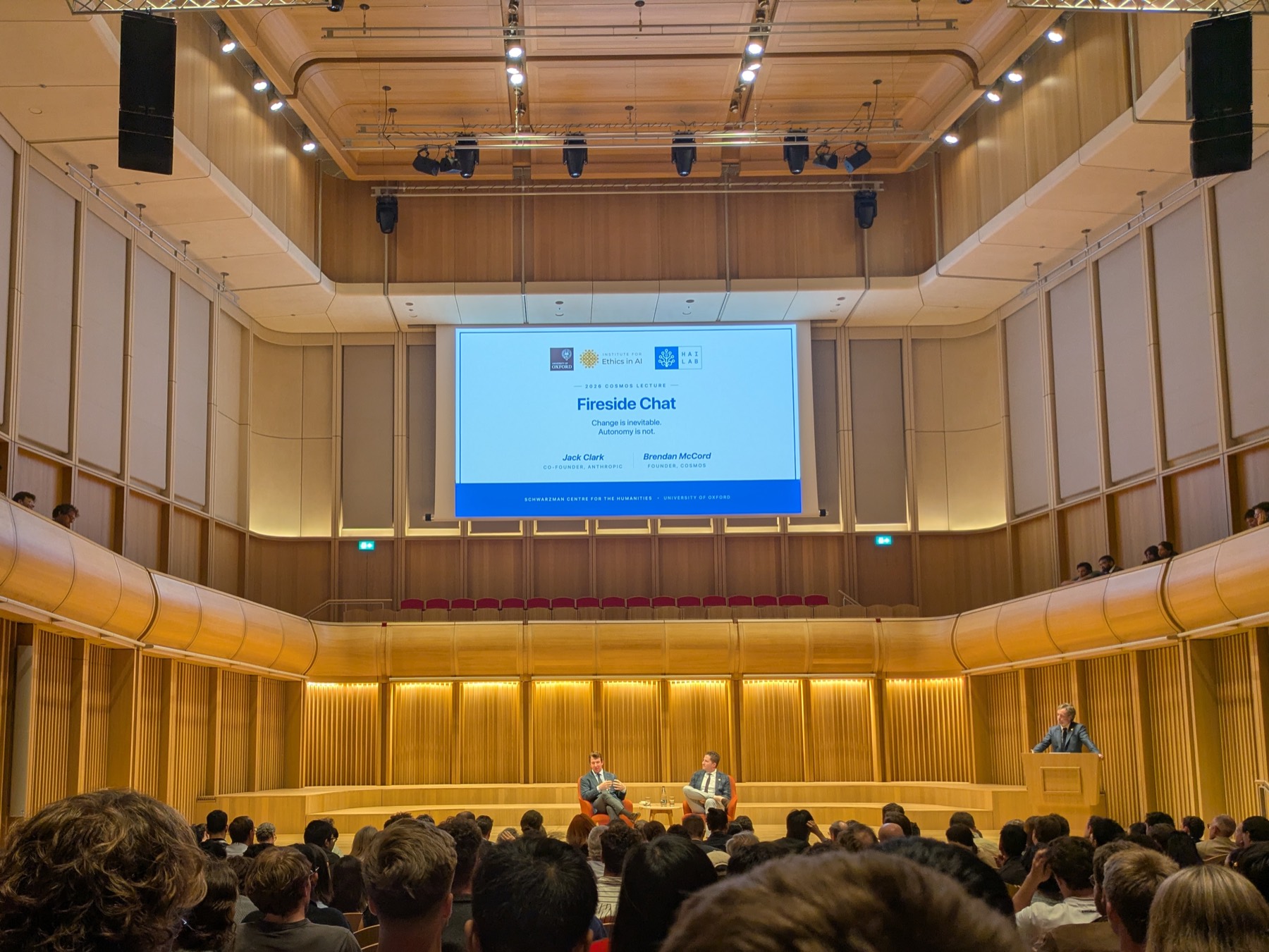
Jack Clark, a co-founder of Anthropic, told economists, central bankers and finance ministers at the IMF and World Bank Annual Meetings in Bangkok on Saturday, Oct. 17, that the singularity has begun 12. He backed the claim with a physics test, two benchmark climbs and an Anthropic model in which U.S. GDP reaches $44 trillion by 2030. Then he asked the room for laboratories, rules and restraint.
Put plainly, a co-founder of the company behind Claude told the people who set budgets and interest rates that machines now speed up science itself. The worry came from the same stage, where V. Anantha Nageswaran, chief economic adviser to the government of India, answered that treasuries and households would carry the cost if the optimism proved wrong 2.
Nigel Clarke, the IMF's deputy managing director and president of the Per Jacobsson Foundation, opened with the lecture's history, noting that "over the 62 years of the Per Jacobsson lecture, a co-founder of a company that is not even 5 years old has never given the Per Jacobsson lecture" 2. Does a lecture move a ledger built on measurements? This one leaves it flat, and the reasons spell out what the ledger would need to see.
Clark set Vernor Vinge's 1993 forecast before the IMF in Bangkok
The International Monetary Fund's schedule put the lecture in room G-01 from 3:00 to 4:15 p.m. Bangkok time, under the title "Inside the Event Horizon: Why Everyone Should Take AI Progress Seriously," and promised a talk on "the capabilities of AI systems to contribute to their own production" 3. Raghuram Rajan of the University of Chicago, who chairs the Per Jacobsson Foundation, moderated, with Nageswaran and Yan Shen of Peking University as discussants.
Clark started with Vernor Vinge, a San Diego State mathematician who took the idea to a NASA symposium in March 1993. "When greater-than-human intelligence drives progress, that progress will be much more rapid," Vinge wrote, calling the singularity "a point where our models must be discarded and a new reality rules" 13. Clark's verdict took four words, "The singularity is here," and his fuller claim dated the start to this year 1. "I believe that this year we have gained convincing evidence that it has now begun," Clark said.
This site's founding paper, Counting Toward Superintelligence, keeps Vinge's window on its table of open forecasts: he would be surprised by an arrival "before 2005 or after 2030" 13. For this ledger, superintelligence needs four things on the public record at once: weeks of unsupervised expert work, ten gigawatts acting as one machine, self-improvement that outsiders measure, and proof to a third party of what ran. Clark's lecture is a claim about the third clause.
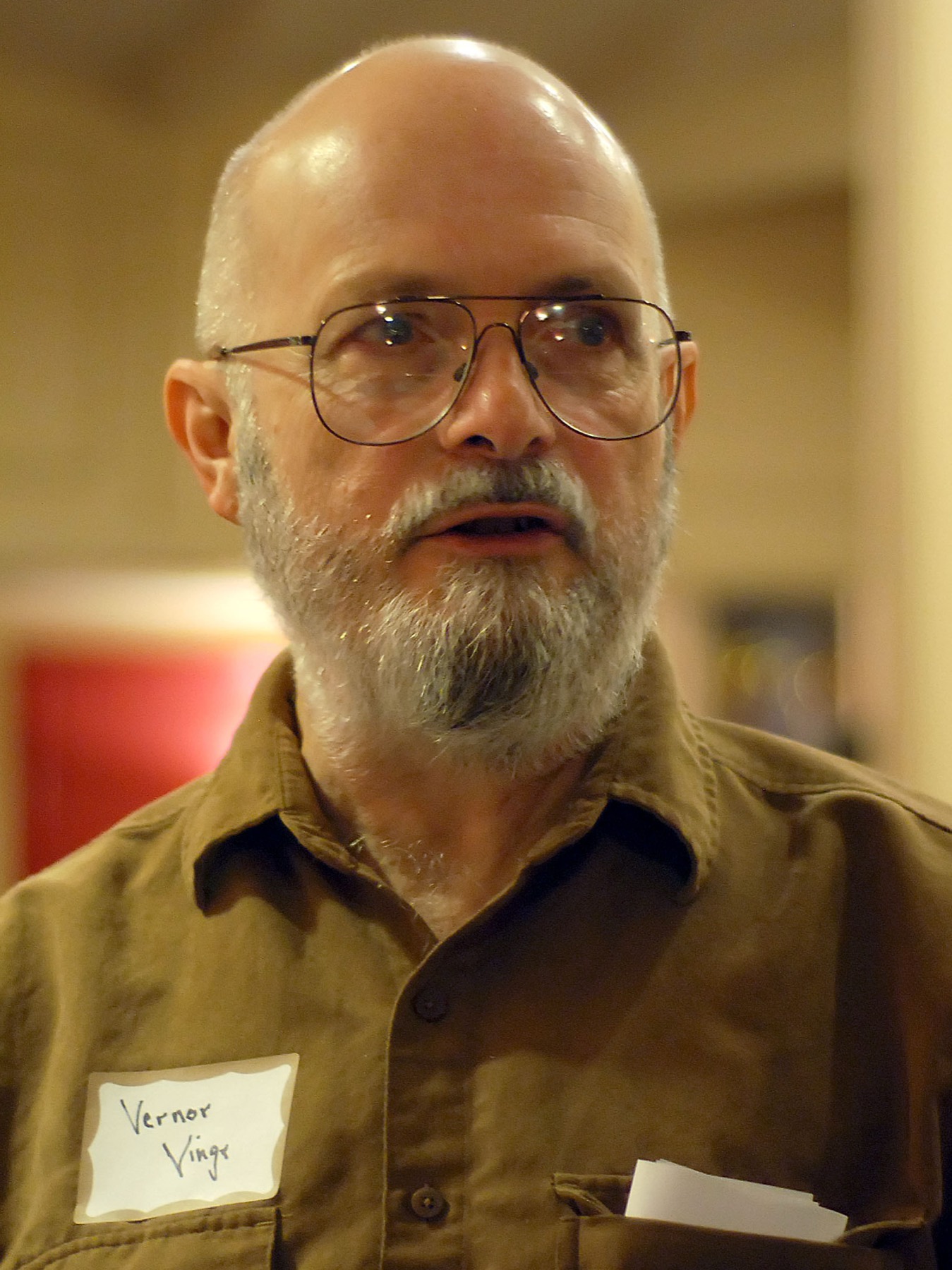

From Vinge's 1993 forecast to the IMF podium in Bangkok
TimelineThe data7 rows · sources
| Date | Event | Source |
|---|---|---|
| Vernor Vinge presents the singularity at NASA's VISION-21 symposium | [13] | |
| Epoch AI posts FrontierMath; the best models solve under 2 percent | [11] | |
| Humanity's Last Exam posts its expert questions, 2,500 once finalized | [12] | |
| Anthropic reports 67.7 percent with tools for Claude Opus 5.5 | [9] | |
| Suvrat Raju posts TheoPhysEval; GPT-6 Astra solves 49 of 50 | [5] | |
| Clark tells the IMF in Bangkok the singularity has begun | [2] [3] | |
| Clark posts the prepared text as Import AI 477 | [1] |
What did Clark offer as evidence?
Three kinds of evidence carried the claim: a count from inside Anthropic, two benchmark climbs and a new physics paper.
The count came first. "We’ve seen concrete evidence of this inside Anthropic, where our researchers now produce almost 10 times the amount of code than they did for the first four years of the company’s life," Clark said 1. On the IMF's recording he added that the increase "basically directly tracks advancing AI capabilities" 2. This desk found the figure first in this lecture. Anthropic's September measurement post counts something else: the 26 percent of its AI research that Claude leads 8.
Clark then cited two climbs 1. Humanity's Last Exam, he said, went from a top score of 8 percent in January 2025 to 67.7 percent for Claude Opus 5.5. FrontierMath went from 2 percent at its November 2024 launch to 94 percent. The exam's leaderboard lists OpenAI's o1 at 8.0 12. Epoch AI's launch paper put the best models "under 2%" 11, and Epoch's data show GPT-6 Astra at 93.7 percent on Tiers 1 through 3 10. One caveat: the 67.7 is Anthropic's own run with tools 9, and Artificial Analysis measured 61.4 on its own harness.
The physics paper carried the story. TheoPhysEval, posted to arXiv on Oct. 9 by Suvrat Raju of the International Centre for Theoretical Sciences and 34 co-authors, sets 50 unpublished research problems whose answers can be checked 5. "When we went back to the experts it turned out, in multiple instances, that the experts found some subtle errors buried deep inside their calculations," Raju wrote in a post that Clark read aloud 1. The paper puts it in its own words: "after the experts corrected their solutions, Astra’s solution was found to be correct." GPT-6 Astra, OpenAI's model, solved 49 of the 50 problems at an average cost under $3 a problem, and Opus 5.5 solved 46.
Why should a central banker care about a physics exam? Clark's answer was growth, because AI working at the frontier lets a country add "100s or 1000s of times as many researchers to any problem" 1.

Three tests Clark cited, at the start and in October 2026
ComparedThe data6 rows · sources
| Item | Value | Source |
|---|---|---|
| Humanity's Last Exam o1 on the exam's board | 8 | [12] |
| Humanity's Last Exam Opus 5.5 with tools, Anthropic's run | 67.7 | [9] |
| FrontierMath best at launch, under 2 | 2 | [11] |
| FrontierMath Tiers 1-3 GPT-6 Astra, Epoch data | 93.7 | [10] |
| TheoPhysEval GPT-6 Astra, realistic track | 98 | [5] |
| TheoPhysEval Opus 5.5, realistic track | 92 | [5] |
Anthropic's $44 trillion comes from its own extreme scenario
Clark tied the science to an economic model built by Anthropic's own economists. "If you assume that models will be able to autonomously complete a broad range of tasks and will diffuse quickly in the economy, then under these singularity-esque conditions, we could see an unprecedented economic transformation, with US GDP reaching 44 trillion by 2030," Clark said 1. "This sounds outlandish, but it’s implicated by the technology continuing to get better," he added. Reuters set the figure beside a U.S. economy of "just over $30 trillion" today 4.
Anthropic's scenario explorer states the number 6. It lists three paths for U.S. GDP in 2030 at 2025 prices: $34.1 trillion in a modest case, $36.3 trillion in a substantial one and $44.4 trillion in an extreme one, 32.4 percent above the baseline path. "This scenario would likely require recursively self-improving AI, adopted quickly for knowledge work," Anthropic wrote of the extreme case, which matches the views of about 10 percent of the Americans it surveyed. In the working paper behind the explorer, labor's share of income falls from 60 to 45 percent 7. So Clark's $44 trillion is a forecast that assumes the self-improvement his lecture set out to show.
Anthropic's three paths for U.S. GDP in 2030
ComparedClark asks for laboratories and robots the way he once asked for data centers
For a decade, Clark told governments to build electricity capacity and data centers for AI. "Not many policymakers listened," he said, and capacity now sits in the United States, China and increasingly the Middle East 1. His new request moves the buildout from server halls to laboratories. "Therefore, just as we did with compute and power, we will want to use much more scientific equipment and robotic systems or we will run very quickly out of capacity," Clark said.
He put numbers on the gap. Clark counted about 10 million scientists, citing UNESCO, whose science report gives 8.854 million full-time-equivalent researchers for 2018 114. He asked what happens with "a billion virtual scientists directed by our own ten million," and he named a physical shortage: "too few biological labs to develop and test new drugs." Anthropic itself leased 95 megawatts at EverWind's Nova Scotia campus the day before the lecture, and those megawatts are still being built.
Nageswaran answered from the receiving end
Clark closed on restraint. "For us to get through this – to chart a course through the singularity – we are going to need to work together to create unusual and serious rules for this technology and the companies building it," Clark said 1. He asked to "go slowly and deliberately on developing the technology itself, to pace or otherwise control its development." Dario Amodei, Anthropic's chief executive, made the case in September, and this site weighed it in its moral-record profile. "We must slow the pace at which we improve the capabilities of AI models," Amodei wrote 15.
Nageswaran took the other side. "I offer the view from the receiving end and from an economy that is rich in labor," he said 2. "Finance ministries, central banks, and households will pay the bill if today's optimism on AI proves wrong. They may pay part of it even if it proves right," Nageswaran said. His reply on restraint was blunt: "Nobody pays the lab for restraint, and we have seen this structure before. It was called banking before 2008."
A Reuters report the same day sits beside his point: Anthropic is preparing a public offering expected in November that could value the company at up to $2 trillion 4. "Anthropic's own modeling has an extreme scenario in which the American economy is a third larger by 2030," Nageswaran said, reading the company's model back to its author, and he added that labor's share falls "from about 60 to 45%" in that case 2. Anthropic's working paper confirms both figures and puts knowledge workers' wages 11.5 percent under the baseline path 7.
"Finance ministries could keep AI's productivity dividend out of their forecasts until it shows up in the data," Nageswaran said 2. Count it when it shows up in the data: this ledger runs on the same rule.
Yan Shen brought data from China 2. In studies she presented, more AI use at listed firms raised productivity while returns on assets and equity had yet to rise. Rajan then put the existential question to the panel: "Now, is humanity doomed because we fear other humans more than we fear extinction?" Clark answered that "humanity is not doomed," and in a later answer he said "we are well in control of this technology now."

The builder's view against the view from the receiving end
Both sidesThe data2 rows · sources
| Side | Who | Claim | Source |
|---|---|---|---|
| For | Jack Clark | The singularity has begun: AI now speeds up science and its own development, so governments should build labs and robots and write unusual and serious rules. | [1] |
| Against | V. Anantha Nageswaran | Treasuries and households pay if the optimism proves wrong; a lab that slows down loses its valuation, so keep AI's dividend out of forecasts until data show it. | [2] |
Where this sits on the ledger
Autonomy holds flat at reported confidence, for four reasons: kind, overlap, method and scenario.
- Kind: a lecture is a statement, and the method weighs a statement below an energized site, a measured result or a regulator's order.
- Overlap: the measured results Clark cited belong to third parties and already moved capability through FrontierMath Tier 4, the Fermat formalization and the Navier-Stokes proof, so counting them here would count them twice.
- Method: the one new figure, almost 10 times the code, is Anthropic's count of its own output with its method unpublished 1, and Chris Painter's Senate testimony already moved autonomy on the company's own count of Claude's research.
- Scenario: the $44.4 trillion is Anthropic's extreme-case estimate, and it assumes the self-improvement in question 6.
TheoPhysEval is the strongest evidence in the lecture, and it deserves a piece of its own. Researchers outside OpenAI and Anthropic ran it. The problems are unpublished, and their answers, in the paper's words, "cannot be guessed" 5. Its authors also state its limits: the problems are "turn-the-crank" research tasks, and "we cannot rule out data leakage." Raju and his co-authors put it plainly: "At present, agents cannot simply be given a major physics problem and expected to solve it autonomously." A capability step on that paper belongs to its own piece, and this one keeps it out of the move.
On its own, this piece holds the reading at 3.0, where the ledger stood after Oct. 16. Anthropic's September post states the gap the lecture leaves open: "As of August 2026, Claude is not operating fully autonomously for any measured subset of AI R&D work" 8. Autonomy moves when an outside evaluator measures how much of Anthropic's research its models do, on a published method.
What the lecture put on the record, and what rests on Anthropic's word
The recordThe data9 rows · sources
| Column | Item | Source |
|---|---|---|
| On the record | Clark gave the 2026 Per Jacobsson lecture in Bangkok on Oct. 17 | [2] [3] |
| On the record | TheoPhysEval: GPT-6 Astra solved 49 of 50 unpublished physics problems | [5] |
| On the record | Experts corrected subtle errors in their own reference solutions | [5] |
| On the record | Anthropic's explorer lists $44.4 trillion as its extreme 2030 path | [6] |
| On the record | Anthropic: Claude led 26 percent of its AI research in August | [8] |
| Claimed or open | Almost 10 times the code: Anthropic's own count, method unpublished | [1] |
| Claimed or open | The singularity has begun: Clark's reading of the evidence | [1] |
| Claimed or open | The extreme path assumes recursively self-improving AI | [6] |
| Claimed or open | TheoPhysEval's authors leave data leakage open as a possibility | [5] |
Clark's lecture leaves the autonomy reading flat
The moveThe data5 rows · sources
| Measure | Value |
|---|---|
| Reading before this day | 3.0 |
| This piece's move | 0.0 (Autonomy, reported) |
| Band for reported evidence | 0.3 to 0.8 |
| Reading after the day | 3.0 |
| Distance to 100 | 97.0 |
By the numbers
- 62 years: the Per Jacobsson lecture's run, by Nigel Clarke's count 2
- 49 of 50: TheoPhysEval problems GPT-6 Astra solved with tools and web access; Opus 5.5 solved 46 5
- $44.4 trillion: U.S. GDP in 2030 under Anthropic's extreme scenario, at 2025 prices 6
- 60 to 45 percent: labor's share of income in that scenario 7
- 8.854 million: full-time-equivalent researchers worldwide in 2018, by UNESCO's count 14
- Almost 10 times: Anthropic researchers' code output against the company's first four years, by Clark's account 1


What to watch
Three kinds of evidence would change this reading. An outside count of AI-written research inside Anthropic, by METR, the UK AI Security Institute or Epoch AI, would move autonomy. Its authors would need to publish freely, which Reuters reported Anthropic sought to control. A replication of TheoPhysEval on fresh problems would carry a capability step. Governance moves when a finance ministry adopts Nageswaran's rule, or a legislature writes the "unusual and serious rules" Clark asked for 12.
The human stakes sit with the 8.854 million researchers UNESCO counts 14. Clark described one of them, a physics student in Tokyo who told him AI was already beginning to be able to do many experiments, which leaves the student to choose which ones to run by hand 1. The open question is whether the labs will publish their own acceleration in a form outsiders can check before Vinge's 2030 window closes.
Sources
- 1Import AI 477: In which I tell the IMF the Singularity has begun, Import AI, Jack Clark, Oct. 19, 2026
- 2Per Jacobsson Foundation Lecture: Inside the Event Horizon, International Monetary Fund (YouTube), IMF, Oct. 17, 2026
- 3Per Jacobsson Foundation Lecture, International Monetary Fund, IMF, 2026 Annual Meetings schedule, Oct. 17, 2026
- 4AI rapidly improving, could vastly boost U.S. GDP, Anthropic's Clark tells policymakers, CNBC (Reuters), Reuters, Oct. 17, 2026
- 5TheoPhysEval: Assessing AI agents at autonomous theoretical physics problem solving, arXiv, A. Ramesh Chandra, Suvrat Raju and 33 others, Oct. 9, 2026
- 6Scenarios for our Economic Future, Anthropic, Anthropic Economics team, Sept. 2026
- 7Economic Scenarios for Transformative AI, Anthropic, Anton Korinek, Charles I. Jones, Szymon Sacher, Tess Cotter and Peter McCrory, Sept. 2026
- 8Measurements for understanding the pace of AI development inside frontier labs, Anthropic, The Anthropic Institute, Sept. 2026
- 9Introducing Claude Opus 5.5, Anthropic, Sept. 22, 2026
- 10Benchmarking data: FrontierMath Tiers 1-3 (v2), Epoch AI, Oct. 19, 2026
- 11FrontierMath: A Benchmark for Evaluating Advanced Mathematical Reasoning in AI, arXiv, Elliot Glazer, Ege Erdil, Tamay Besiroglu and others, Nov. 7, 2024
- 12Humanity's Last Exam, Center for AI Safety and Scale AI, Long Phan, Alice Gatti, Ziwen Han and others, Jan. 24, 2025
- 13The Coming Technological Singularity: How to Survive in the Post-Human Era, VISION-21 Symposium, NASA Lewis Research Center, Vernor Vinge, March 30, 1993
- 14UNESCO Science Report: Facts and figures, UNESCO, 2021
- 15We Must Pace the Frontier, darioamodei.com, Dario Amodei, Sept. 2026