FERC Rejects PJM's Plan to Curtail New Data Centers First and Keeps Its 50-Megawatt Registry
FERC's Oct. 9 order accepted PJM's 50-megawatt large-load definition and registry and rejected the Interim Resource Adequacy Service, so governance moves down 0.4.
By Ryan Elliott Dennis · 6 sources · 7 min read
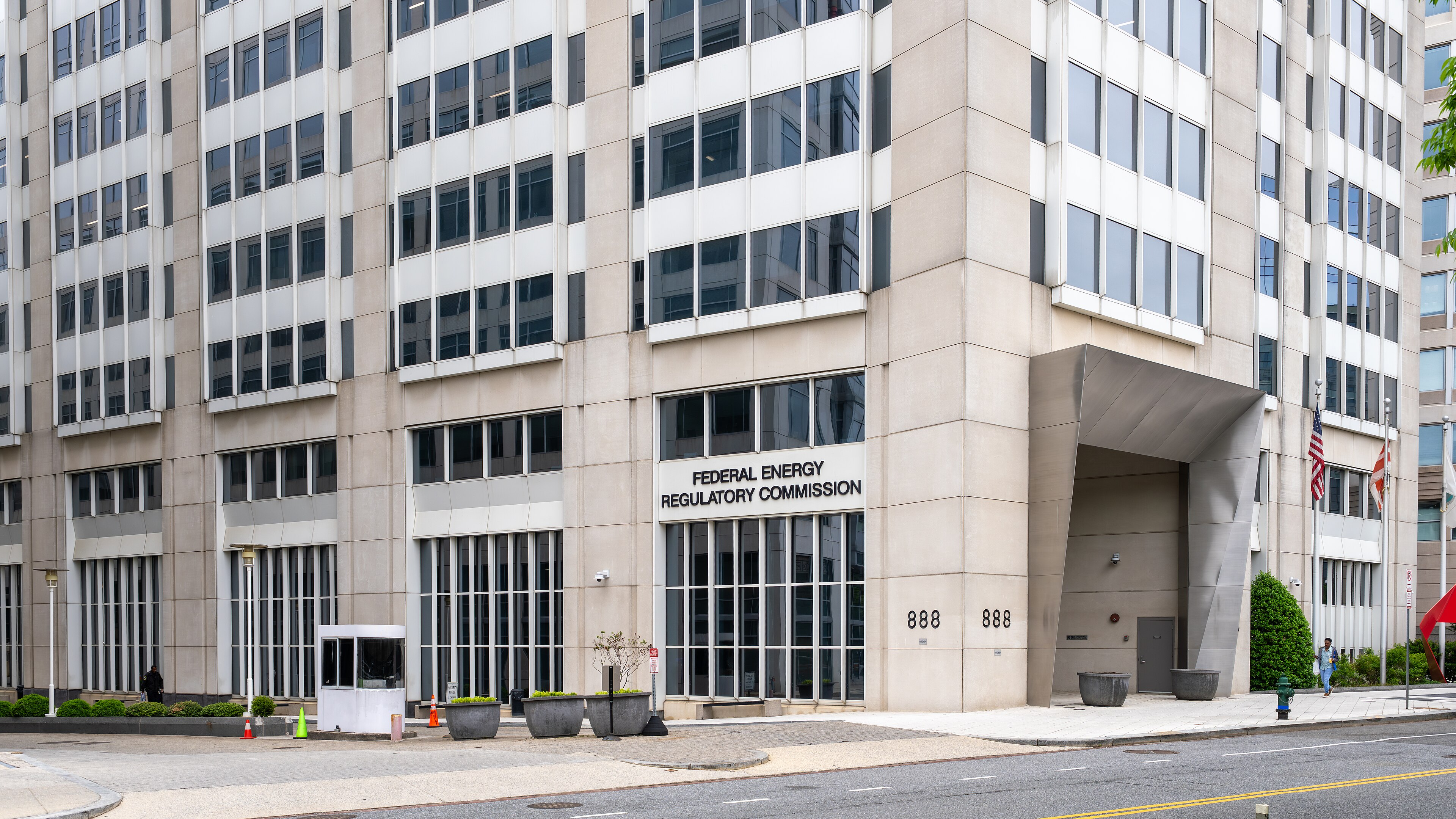
The Federal Energy Regulatory Commission rejected the core of PJM Interconnection's data-center plan on Oct. 9, 2026, and approved two of its supporting pieces 1. FERC turned down the Interim Resource Adequacy Service, the rule that would have let new data centers connect before matching generation existed, and accepted a 50-megawatt definition of a large load plus a registry of every such site 2. PJM filed the plan on Aug. 13 in a 435-page package, and PJM itself projects 32 gigawatts of load growth by 2030, with data centers supplying 30 of them 3.
Call the rejected rule IRAS, short for Interim Resource Adequacy Service. PJM wrote it for load that outruns supply, and FERC's answer on Oct. 9 gave PJM the counting tools while withholding the switch.
FERC's Oct. 9 order lowers governance 0.4 points
The moveThe data5 rows · sources
| Measure | Value |
|---|---|
| Reading before this day | 2.5 |
| This piece's move | −0.4 (Governance, confirmed) |
| Band for confirmed evidence | 0.8 to 1.5 |
| Reading after the day (with 2 other pieces that day) | 2.1 |
| Distance to 100 | 97.9 |
FERC kept the registry and rejected the curtail-first service
Two piles came out of PJM's proposal. In the accepted pile sit the definition of a large load, which means 50 megawatts or more of peak demand at one site or at affiliated sites within one mile, and the registry that tracks each facility's location, ramp schedule and capacity supply 23. "We find that those two elements of PJM's proposal are just and reasonable and not unduly discriminatory or preferential," the Federal Energy Regulatory Commission wrote 1.
Rejection fell on IRAS, the "bring your own new capacity" requirement and the exclusion of new large loads from the capacity auction's demand curve 14. FERC found the capacity-designation duty on utilities serving new large loads foundational to both IRAS and the bring-your-own rule, so the pieces that depended on it fell together. Per the Federal Energy Regulatory Commission, "the only elements of its proposal that are severable are the proposed definition of Large Load" and the registry.
One more item fell on narrower terms. FERC denied PJM's separate "New Large Load" definition, which covers loads starting service after June 1, 2027, and left PJM free to refile it 3.
Why did FERC reject a plan that states had praised?
Jurisdiction is the reason. FERC regulates wholesale power. States regulate what a retail customer pays and when a retail customer loses service. Several IRAS provisions, in the Commission's reading, "appear to place obligations directly on eligible new large loads," and the compensation terms appeared to set a retail rate 2.
PJM Interconnection had expected that argument and answered it in advance. In its Sept. 23 reply, PJM Interconnection wrote that "PJM stands behind the IRAS proposal as a just and reasonable and not unduly discriminatory or preferential response" 5. The same filing records that the Pennsylvania governor's office and New Jersey's utility board had called the design balanced between state and federal roles. Opponents who raised jurisdiction, PJM wrote, "conveniently overlook" that integrating large loads is shared work between the states and PJM.
On law, FERC sided with the opponents, and on the problem it sided with PJM. "States have a crucial role to play in this challenge," the Commission wrote, and it said it "strongly encourage[s] states to continue their important work on this issue" 2. Read that second sentence as an instruction: curtailment priority belongs in Columbus, Harrisburg and Richmond.
Six dates from the White House pledge to PJM's next possible start
TimelineThe data6 rows · sources
Who is hurt when the curtailment rule disappears?
Monitoring Analytics, PJM's Independent Market Monitor, also asked FERC to reject IRAS, and for the opposite reason: it wanted a tougher rule. Its Sept. 3 protest called IRAS "a convoluted, inconsistent, confusing proposal that PJM justifies based on a misreading of jurisdictional responsibilities and under which PJM denies responsibility for reliability and assigns key undefined and inappropriate roles to the states" 6. The remedy it proposed makes any data center that connects lacking new capacity contract for curtailment.
Both critics cited the same document. The White House issued the Ratepayer Protection Pledge on Mar. 4, 2026, and it says hyperscalers and AI companies "will build, bring, or buy the new generation resources and electricity needed to satisfy their energy demands" 6. PJM Interconnection counts more than 300 organizations as signers, among them 44 data-center developers and seven AI companies 5. Signers pledged supply, and enforcement waits for a later order.
Commissioner David Rosner filed a concurrence that explains what is at stake for households. He warned that a rule leaving large loads out of the auction's demand curve could let the capacity market show a surplus while "the region sheds thousands of megawatts of demand on an involuntary basis" 2. In a separate passage he wrote that "in an emergency, data centers not serving critical functions should be shut off before ordinary customers" 3. Rosner also wrote that state regulators should "establish clear rules for which customers should be curtailed first". His concurrence reads as a request to the states.


PJM defends IRAS; the Market Monitor calls it confusing and wants it rejected
Both sidesThe data2 rows · sources
| Side | Who | Claim | Source |
|---|---|---|---|
| For | PJM Interconnection | PJM stands behind the IRAS proposal as a just and reasonable and not unduly discriminatory or preferential response. | [5] |
| Against | Monitoring Analytics | The IRAS Filing is a convoluted, inconsistent, confusing proposal that PJM justifies based on a misreading of jurisdictional responsibilities. | [6] |
The case for the move: the shortfall stays and the tool is gone
PJM's grid serves 13 states, the District of Columbia and more than 67 million people, and it hosts the largest concentration of data centers in the world, by PJM's own description 5. Per its Sept. 23 reply, PJM Interconnection told FERC that its 2027/2028 capacity auction procured too little to meet the region's reliability requirement, so whether the region has enough capacity on June 1, 2027 is an open question. The 2028/2029 auction procured 138,318 megawatts and finished 6,831 megawatts short 4.
PJM designed IRAS for that gap. In the words of PJM Interconnection, new large loads that arrive with zero new capacity "must be flexible and, pursuant to PJM's operational needs, reduce their energy demands when called upon during system emergencies" 5. FERC's rejection removes the one tool PJM had written for connecting a load first and finding its supply later. Mgrid's reading ties the order to the Sept. 29 suspension of PJM's backstop procurement, which postponed the supply side for five months 4. Both of PJM's answers to the shortfall are now on hold at once.
Investors noticed the consequence. Jefferies named Constellation, NRG, Talen and Vistra as likely winners from higher prices that last longer 4. A registry counts megawatts, and construction is a separate job. The 30 gigawatts of data-center growth PJM forecasts still have to find generation, and the order returns the question of who pays for curtailing them to 13 state capitals 3.


Data centers supply 30 of PJM's 32 gigawatts of forecast load growth
ComparedThe case for a smaller step
FERC left the door open, and that is the strongest reason to size this move small. Jeffrey Shields, a PJM spokesman, said PJM is reviewing the order "with an eye toward how we can fulfill FERC's requirements" 2. Analyst Rao Konidena reads the order as an invitation to refile under Section 205 of the Federal Power Act 4. Jefferies analysts wrote that "we could see this proposal minimally revived in future iterations and likely led by efforts from states".
Weight also sits in the accepted half. A registry that records ramp schedules gives PJM and the states the first region-wide list of where large loads sit and how fast each one can change its draw 2. That list feeds the December capacity auction and every state curtailment rule written afterward 1. FERC found the definition and the registry severable, so they stand regardless of how IRAS returns.
A third fact limits the step. Zero energized megawatts of compute change and zero campuses cancel. A proposed rule is gone, which is a smaller loss than a power plant.
Where this sits on the ledger
Governance asks whether the rules allow deployment at the definition's scale. On Oct. 9 a regulator's order confirmed that PJM lacks the authority to write its own curtailment rule for new data centers. Confirmed evidence of that kind points down.
Confirmed moves run from 0.8 to 1.5 points. A piece may step below that band when it states the reason, and three reasons apply: the registry and the definition survived, FERC invited a refiling, and governance carries a weight of 0.05. Governance moves down 0.4.
By the numbers
- 30 of 32 gigawatts of PJM's forecast 2024 to 2030 load growth come from data centers 3
- Oct. 9, 2026 is the date of FERC's order in Docket ER26-3515 1
- 50 megawatts of peak demand at one site, or at sites within one mile, defines a large load 3
- A 435-page filing from Aug. 13 drew replies from utilities, states, Google and the Data Center Coalition 3
- PJM's 2028/2029 capacity auction procured 138,318 megawatts and finished 6,831 short 4
- Forty-four data-center developers and seven AI companies had joined the Ratepayer Protection Pledge by PJM's count 5
- June 1, 2027 was the target start for the rejected rules 1
What to watch
A PJM refiling is the first signal, and Jefferies expects it to be led by states, with Ohio and Pennsylvania the ones to follow 2. The December capacity auction will show how much price pressure builds with the registry in place and IRAS absent 1. A state commission that adopts its own curtailment priority would confirm FERC's reading of the law and reverse part of this move on a later day. Another FERC order that blocks the registry or the remaining pieces would deepen it.
Sources
- 1FERC Accepts Elements of PJM Proposal Tied to Large Loads, Rejects Others, American Public Power Association, Paul Ciampoli, Oct. 13, 2026
- 2FERC rejects most of PJM's large load interconnection plan, Utility Dive, Ethan Howland, Oct. 12, 2026
- 3FERC OKs part of PJM's data center plan, rejects the rest, The Dominion Post, David Beard, Oct. 13, 2026
- 4FERC Rejects PJM's Curtail-First Plan for New Large Loads, and Keeps Only the 50 MW Definition and a Registry, mgrid, Oct. 10, 2026
- 5Motion for Leave to Answer and Answer of PJM Interconnection, L.L.C., Docket No. ER26-3515-000, PJM Interconnection, Sept. 23, 2026
- 6Protest of the Independent Market Monitor for PJM, Docket No. ER26-3515-000, Monitoring Analytics, Sept. 3, 2026