Nebius Takes Prepayments Above the Capex of Its Q3 Deals While Microsoft's New Jersey Capacity Slips
Nebius told shareholders on Nov. 12 that customers prepaid more than the capex on its third-quarter deals, then moved Microsoft's remaining New Jersey tranches to the second quarter of 2027.
By Ryan Elliott Dennis · 5 sources · 7 min read

Nebius told shareholders on Nov. 12, 2026 that customers prepaid more than 100 percent of the capital spending behind its third-quarter contracts, up from 50 to 60 percent in the second quarter 1. The same letter moved the remaining Microsoft capacity at a New Jersey colocation site to the second quarter of 2027 and cut 2026 revenue guidance to the low end of $3.0 billion to $3.4 billion. Nebius shares closed at $128.64, down 17 percent on the day 5.
Nebius's Nov. 12 prepayments add 0.4 points to capital
The moveThe data5 rows · sources
| Measure | Value |
|---|---|
| Reading before this day | 5.5 |
| This piece's move | +0.4 (Capital, reported) |
| Band for reported evidence | 0.3 to 0.8 |
| Reading after the day (with 2 other pieces that day) | 6.4 |
| Distance to 100 | 93.6 |
What did Nebius customers pay in advance?
Start with the balance sheet. Nebius reported $9.4 billion of deferred revenue at Sept. 30, split between $1.45 billion current and $7.96 billion due after 12 months, against $7.43 billion of cash 2. Quarterly purchases of property and equipment reached $7.30 billion, compared with $955.5 million a year earlier. Deferred revenue is cash received for service still owed, so customers have funded the build ahead of delivery.
The letter gives the structure. More than 90 percent of the contract value signed in the third quarter carried a prepayment, and the weighted average prepayment as a share of contract value rose by about 20 percentage points from the second quarter 1. Chief Financial Officer Dado Alonso gave the ratio on the earnings call. "Coverage is, as Arkady described, more than 100% of the CapEx behind our Q3 wins, up from 50% to 60% in the second quarter," he said 3. Note the phrase "behind our Q3 wins." The ratio measures one quarter's deals against the capex those deals require, and the 2026 total is a different sum.
Prices explain why customers accept the terms. Annual contract value per megawatt exceeded $25 million on Q3 deals, and the payback period on comparable one-to-three-year agreements fell to 1 year and 7 months from 1 year and 10 months 1. Nebius expects $10 billion of committed customer prepayments in 2026 and $17 billion to $20 billion in 2027. CoreWeave's third-quarter release, filed two days earlier, shows the same direction. Chief Executive Michael Intrator cited "approximately $9 billion in customer prepayments and deposits expected in the next three months alone" 4.
Nebius holds $9.4 billion of customer prepayments against $14.2 billion of debt
ComparedWho carries the delay when capacity arrives late?
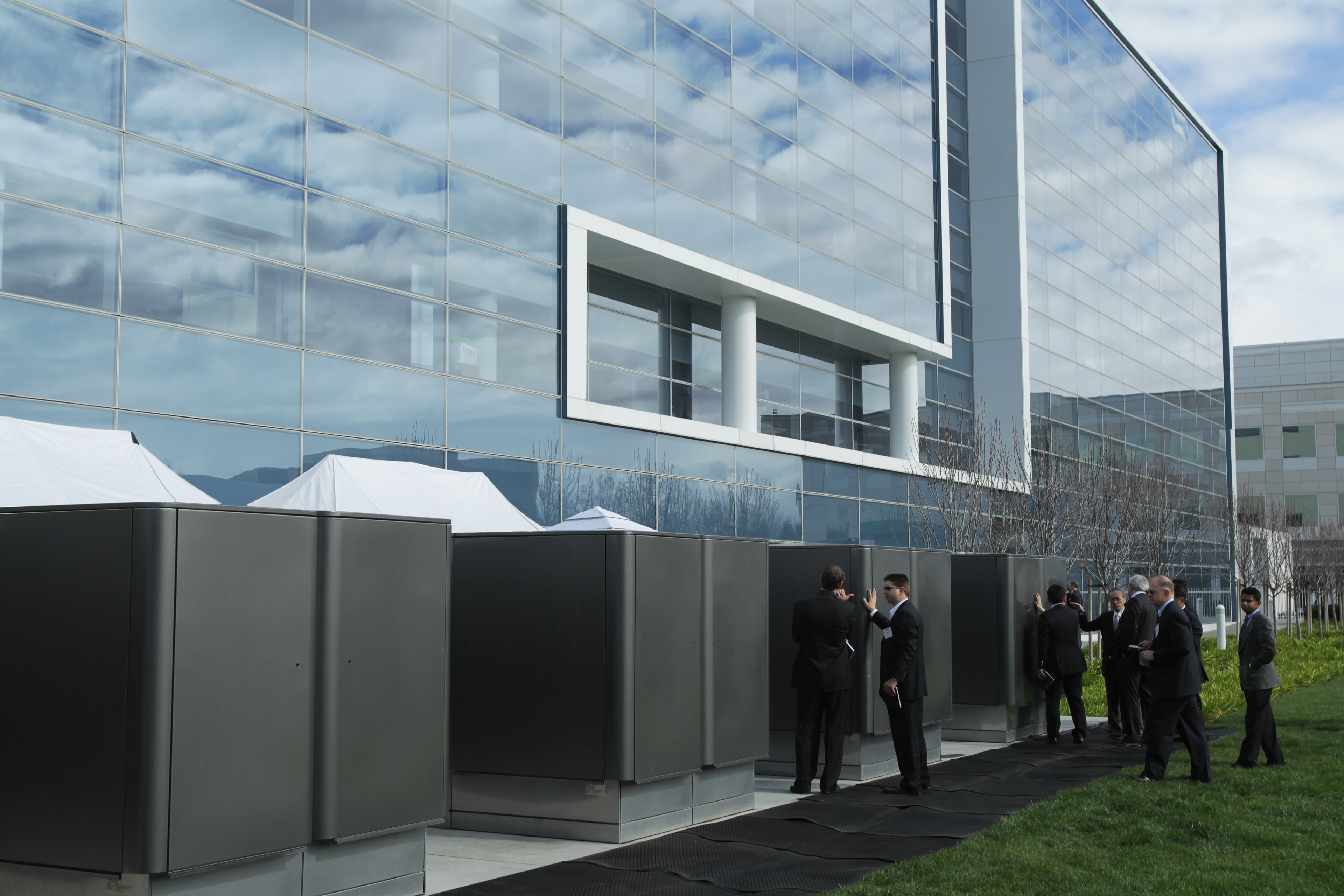
A customer that prepays owns a claim on delivery. Nebius named the delays itself. "Where we rely on third parties, there have been delays," Chief Executive Arkady Volozh wrote 1. In New Jersey, the site operator DataOne began retiring temporary generation late in the third quarter, ahead of the move to permanent power, and that decision reset the schedule for the remaining tranches. Nebius now expects to deliver more than half of the capacity contracted with Microsoft by the end of 2026, with the rest scheduled for 2Q27. Bloom Energy fuel cells are becoming the main power source, and Nebius says Bloom generation is online and scaling.
Count what the slip touched. The 2026 revenue guide fell to the low end of its range, and Nebius moved its December annualized run-rate revenue target of $7 billion to $9 billion to February 2027, when it expects more than $7 billion 1. Then Nebius retired the metric. The letter says "We no longer see ARR as the right measure of our business," citing its dependence on a single month of the quarter. A guide that slips two months and then leaves the reporting set is worth a second look, though the letter also offers revenue and pre-tax earnings as replacements.
Revenue quality adds a second reading. Nebius recognized about $325 million in the quarter that it calls "non-recurring," earned from partners deploying the Nebius platform on their own funded capacity, so $656 million of the $980.8 million total is the base figure by this desk's arithmetic 1. The balance sheet shows receivables of $4.04 billion against $720.3 million at Dec. 31, 2025, which is 5.6 times as much 2. Ray Myers, who writes Global Equity Briefing, counted the concentration: "Nebius still depends on a few big customers, as 3 made up 70% of Q3 revenue" 5.

Nebius's delivery dates move from 2026 into 2027
TimelineDoes CoreWeave's quarter confirm the pattern?
It does for prices and for prepayments, and it adds a cost that Nebius carries less of. CoreWeave reported Q3 revenue of $3.66 billion, a backlog of $132.5 billion and total debt near $46.9 billion, with net interest expense of $846 million in a quarter that produced $207 million of operating income 4. Nebius carries $14.2 billion of debt 2. Both companies raised capital spending guidance in the same week: CoreWeave to $37 billion to $39 billion for 2026, and Nebius to about $27 billion from $20 billion to $25 billion1.
Nitin Agrawal, CoreWeave's chief financial officer, described the price on his own call. "Pricing for long-dated customer contracts is going up to $20 million-$25 million per megawatt," he said 5. Two companies with different customers and different debt loads report the same price band for long contracts, which makes the Nebius figure a market reading and a company reading at once. That outside match carries the claim that prepayments are becoming the standard way these builds are paid for.
What would each side need to be true?
Volozh speaks for the model. His letter says: "We expect prepayments and financing against existing contracts with investment-grade customers to cover 75%-85% of our 2027 capex, and have a wide range of other funding options available" 1. The sentence needs three things to hold. Customers keep prepaying at the Q3 rate, Microsoft and Meta contracts stay financeable against delivery, and the sites open on time. The guidance table words it differently, adding "along with our balance sheet" to the 75 to 85 percent, so the share that prepayments alone cover stays unstated.
Myers speaks against the claim that delivery dates decide the story, and he holds a bullish view of the stock. His verdict: "In conclusion, I think the market overreacted to a few months of delay and ignored the best contracts Nebius has ever signed" 5. Read the phrase "a few months." Two months moved ARR and one quarter moved the Microsoft tranches, which Myers treats as timing. A lender holding the contracts as collateral reads the same dates as the schedule for when the collateral exists. The bear case sits inside the bull's own sentence: the contracts are the asset, and delivery dates decide when they turn into revenue.
The remaining funding sets the scale. Nebius plans $40 billion to $45 billion of capex in 2027 for more than 1 gigawatt of new capacity, against $12 billion to $13 billion of revenue 1. Coverage of 75 to 85 percent leaves 15 to 25 percent, which is $6.0 billion at the low end and $11.25 billion at the high end, by this desk's arithmetic. Cash of $7.43 billion sits inside that range. Nebius lists cash, equity stakes, corporate debt and equity as the other sources.


Volozh counts on 75 to 85 percent coverage; Myers sees months of delay
Both sidesWhy is the step only 0.4?
The reading moves capital up by 0.4 at reported confidence. Evidence for the step is the $9.4 billion deferred revenue balance in the filing, a letter that reports prepayments above 100 percent of Q3 capex, and an outside match in CoreWeave's price and prepayment figures 214. Money in hand from customers who have signed for years is the kind of financing the method counts.
Four facts hold the step in the lower half of the band. The coverage ratio comes from the company and covers one quarter of deals. Remaining performance obligations rose 3 percent in the quarter, to $38.7 billion from $37.5 billion, so contracted revenue grew slowly while quarterly capex rose from $955.5 million to $7.30 billion in a year 12. Third-party sites slipped, and the slip landed on the largest named customer. The 2027 plan leaves a funding range open, with sources listed and amounts unstated.
The strongest fact the other way is the ratio itself: customers paid more than the cost of the buildings and networks their contracts require. Arithmetic and timing answer it. Prepayments are a liability until capacity is delivered, and the same quarter shows delivery slipping at the sites Nebius rents from partners. Volozh says the owned sites "are on time or ahead of schedule" 1. The verdict for a reader tracking the buildout: count Nebius's prepayments as closed customer financing and its third-party megawatts as delayed, and wait for the 2Q27 New Jersey delivery before crediting the contracts as revenue.
What Nebius's Nov. 12 filings confirm, and what stays open
The recordThe data8 rows · sources
| Column | Item | Source |
|---|---|---|
| On the record | $9.4 billion of deferred revenue at Sept. 30 | [2] |
| On the record | Prepayments over 100 percent of Q3 deal capex | [1] |
| On the record | $10 billion of committed 2026 prepayments | [1] |
| On the record | CoreWeave expects about $9 billion of prepayments in three months | [4] |
| Open | Microsoft's remaining New Jersey tranches scheduled for 2Q27 | [1] |
| Open | 15 to 25 percent of $40 billion to $45 billion 2027 capex | [1] |
| Open | Remaining performance obligations up only 3 percent | [1] |
| Open | Three customers made up 70 percent of Q3 revenue | [5] |
By the numbers
- $9.4 billion: deferred revenue at Sept. 30, 2026, split $1.45 billion current and $7.96 billion long-dated 2.
- Over 100 percent: share of Q3-deal capex covered by prepayments, up from 50 to 60 percent in Q2 1.
- $40 billion to $45 billion: planned 2027 capex for more than 1 GW of new capacity 1.
- Fifteen to 25 percent of that capex, $6.0 billion to $11.25 billion by this desk's arithmetic, sits outside the stated 75 to 85 percent coverage 1.
- $38.7 billion: remaining performance obligations, up 3 percent from $37.5 billion in June 1.
- About $325 million of Q3 revenue came from the asset-light partner model, which Nebius itself labels "non-recurring" 1.
- CoreWeave's total debt of about $46.9 billion compares with Nebius's $14.2 billion 42.
What to watch
Delivery of the remaining Microsoft tranches in New Jersey in 2Q27 would confirm the move and release the contract value into revenue. Nebius's next quarterly letter should show whether prepayments on Q4 deals stay above 100 percent of their capex, as the letter says the trend continues. A new debt facility sized near the $6.0 billion to $11.25 billion range would show how Nebius closed the 2027 gap. Another slip at DataOne or an owned site, or a prepayment ratio that falls back toward 50 percent, would reverse the step.
Sources
- 1Nebius Third Quarter 2026 Letter to Shareholders, Nebius Group N.V., Arkady Volozh, Nov. 12, 2026
- 2Nebius Reports Third Quarter 2026 Financial Results, Stock Titan (Nebius release), Nebius Group N.V., Nov. 12, 2026
- 3Nebius Group (NBIS) Q3 2026 Earnings Call Transcript, The Globe and Mail, Nov. 12, 2026
- 4CoreWeave Reports Strong Third Quarter 2026 Results, CoreWeave, Inc., Nov. 10, 2026
- 5Nebius Q3 2026: The Market Overreacted, Global Equity Briefing, Ray Myers, Nov. 13, 2026