Microsoft Commits Its Maia 300 Chip to Multi-Gigawatt Deployments Starting in 2027
Microsoft announced Maia 300 on Oct. 12 and promised multi-gigawatt rollouts from 2027, while every performance figure comes from Microsoft itself; compute moves up 0.3.
By Ryan Elliott Dennis · 8 sources · 7 min read
Microsoft announced Azure Maia 300, the third generation of its in-house AI accelerator, on Oct. 12, 2026 at the OCP Global Summit in San Jose, and committed to scale the Maia family to multi-gigawatt deployments starting in 2027 13. A 96-chip Maia 300 rack draws 167 kilowatts, and Microsoft claims it delivers 40 percent more tokens per megawatt than leading GPU-based systems2.
Microsoft's Oct. 12 Maia 300 plan lifts compute 0.3 points
The moveThe data5 rows · sources
| Measure | Value |
|---|---|
| Reading before this day | 2.1 |
| This piece's move | +0.3 (Compute, reported) |
| Band for reported evidence | 0.3 to 0.8 |
| Reading after the day | 2.4 |
| Distance to 100 | 97.6 |
What did Microsoft commit to on Oct. 12?
Scott Guthrie, Microsoft's executive vice president of Cloud + AI, wrote the announcement on the company blog. "We will scale our Azure Maia family to multi-gigawatt deployments starting in 2027," Guthrie wrote 1. The possessive in "our Azure Maia family" places the chips inside Microsoft's own fleet. Microsoft's post lists only its own services as users, and OpenAI appears as a supplier of models that already run on Maia 200.
Maia 200 is the precedent. It launched in January 2026, serves Microsoft Copilot and the MAI model team, runs OpenAI and open-source models, and is deploying across the United States, Europe and Australia 16. GitHub Copilot and Microsoft Foundry are due to follow by the end of 2026. Microsoft says Maia 200 delivers up to 1.7 times more tokens per watt than leading GPU infrastructure for built-in AI features in Teams, Copilot and Cowork.
Rani Borkar, president of Azure hardware systems and infrastructure, described Maia 300 to Reuters in one sentence. She said it is "delivering more intelligence for every watt, every dollar, and every byte of memory" 5. Three units of cost sit in that list, and each one is a ratio Microsoft measures on its own workloads.


What does the Maia 300 rack contain?
StorageReview's Brian Beeler tabulated the specifications from Microsoft's technical material 2. Each accelerator pairs a TSMC N2P compute die with eight HBM4 memory stacks, 288 gigabytes in total at 18 terabytes per second, inside a 950-watt power budget 1. Peak FP4 throughput rises from 10.1 to 13.8 petaops over Maia 200, about 37 percent, while memory bandwidth grows 2.5 times.
The rack changes more than the chip does. Maia 300 packs 96 accelerators into 167 kilowatts and 27.6 terabytes of HBM, where a Maia 200 rack held 48 accelerators in 64 kilowatts and 10.4 terabytes 2. Microsoft says the full rack delivers up to seven times the token throughput of a Maia 200 rack 1.
Reuters supplied the comparison Microsoft left out. An Nvidia GB300 rack holds 72 GPUs and draws about 142 kilowatts 58. My arithmetic puts Maia 300 at 1.74 kilowatts per accelerator slot and the GB300 at 1.97, though a slot of one design and a slot of the other do different work.
Microsoft also claims more than 2.5 times the performance per watt of Maia 200, while chip power rises 27 percent, from 750 to 950 watts 2. Efficiency gains of that size come from memory bandwidth and rack design, and the technical paper Microsoft promised for its Ignite conference on Nov. 17 to 20 should show which5.
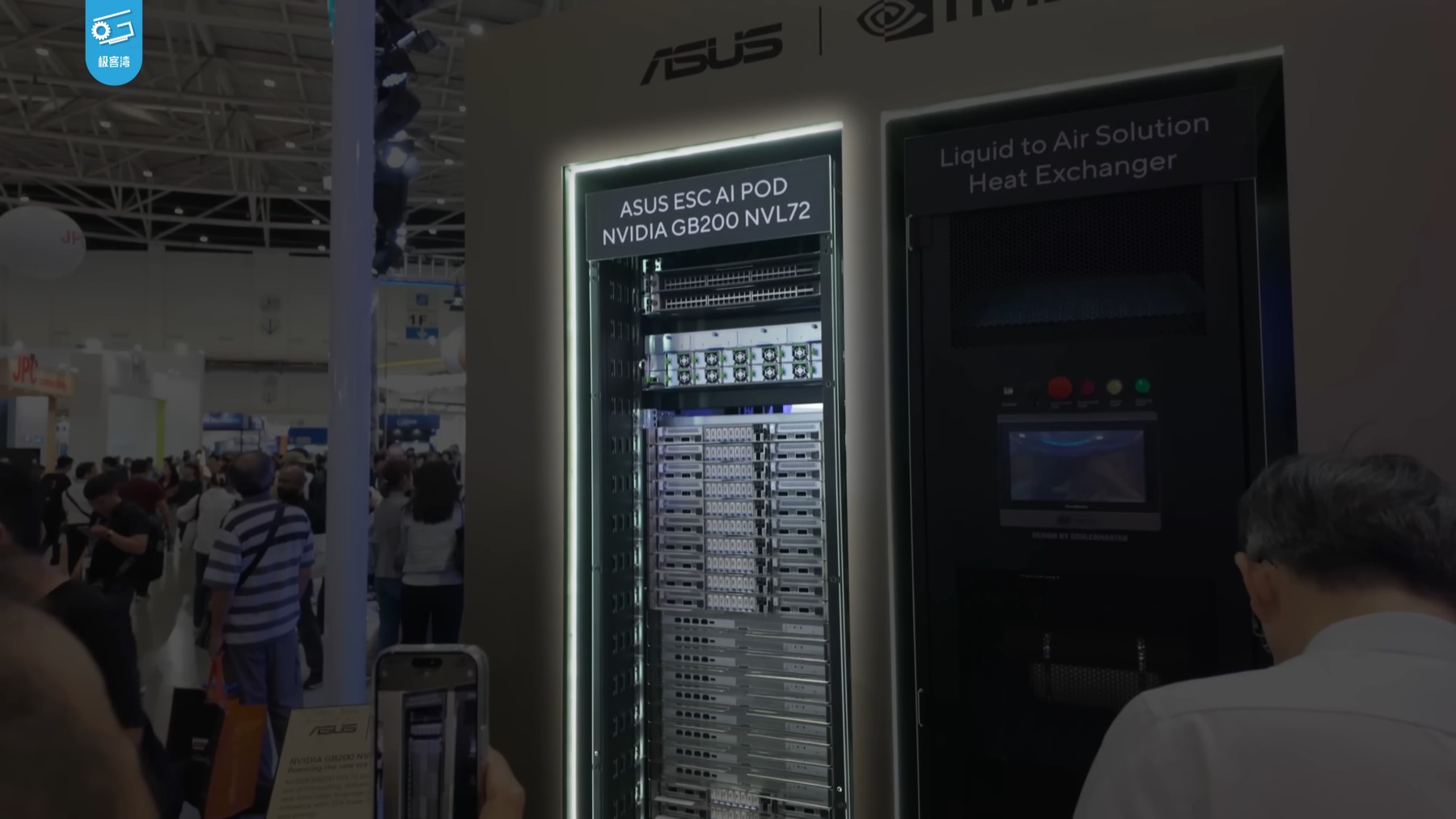

A Maia 300 rack draws 167 kilowatts for 96 accelerators
ComparedHow many chips does multi-gigawatt mean?
Gigawatts count power, so the chip count follows from the rack. At 167 kilowatts, one gigawatt of rack power fills about 5,990 racks, or roughly 575,000 accelerators. That is my arithmetic, and it counts only the racks. Cooling and power conversion add load on top.
Two reported volumes fit that scale. The Information reported in August that Microsoft was discussing TSMC capacity for more than 300,000 Maia 300 chips in 2027, and Reuters now reports a rollout that could reach more than 1 million chips next year 56. Three hundred thousand chips make 3,125 racks and about 520 megawatts. Reaching 2 gigawatts takes about 1.15 million chips, which matches the Reuters figure.
Andrew Wall, general manager of Azure Maia, told Reuters in August that the August report understated the program. "While we don't share production volumes, the figures reported don't reflect the scale of our program," Wall said 6. The sentence confirms scale and withholds the number, and the 300,000 figure was a floor Microsoft chose to leave standing.

Can anyone outside Microsoft check the claim?
Guthrie speaks for the plan, and Gennaro Cuofano, who writes FourWeekMBA's analysis of the hyperscaler chip programs, speaks against reading it as delivered capacity. The two work from different evidence. Guthrie has the roadmap and Cuofano has the record of the last roadmap.
Microsoft frames the efficiency claim as an expectation, in Guthrie's words: "we expect Maia 300 to deliver 40% more tokens per megawatt compared to leading GPU-based systems" 1. The verb "expect" marks a projection for a chip that ships in 2027. Microsoft left the comparison system, the model and the serving configuration unspecified2. UPI adds that outside companies had yet to test Maia 300 as of Oct. 12, and that the gains are stated against Maia 200 4.
Cuofano's case rests on Maia's history. "Microsoft's own track record with Maia argues for treating the ramp as intent rather than achievement," he wrote 7. He put the volume talks in the same category: "These are production talks and volume ambitions, not committed orders or shipped silicon". His piece records that Maia 200 slipped into 2026, and it calls the next constraint a foundry and memory dependency, since TSMC advanced nodes, HBM and packaging serve every AI chip program.
Daniel Howley of Yahoo Finance adds the buyer's view. Hyperscalers will keep buying Nvidia chips for other workloads, he writes, and Nvidia gets more than half its quarterly revenue from them 3. Microsoft's own post supports that reading, since it names Maia as the primary inference system and leaves training to others 1.
Each side needs something specific to be true. Guthrie is right if racks reach Azure halls in 2027 at the stated power and the 40 percent holds on a named baseline. Cuofano is right if volumes stay under negotiation and the ramp slips as Maia 200 did.
Four dated checkpoints test the Maia 300 plan before 2027
TimelineScott Guthrie commits to 2027 scale; Gennaro Cuofano reads it as intent
Both sidesWhy does the step stop at 0.3?
A company announcing its own plan is the evidence here, which the method rates as reported, with a band of 0.3 to 0.8 points. Compute carries a weight of 0.20, and a multi-gigawatt commitment from one of the largest buyers of AI hardware belongs in that band 1.
The step sits at the bottom of the band for four reasons. First, production deployments begin in 2027, so the announcement describes hardware that exists as a specification 14. Second, all performance figures are Microsoft's, and the baseline is unnamed2. Third, outside companies had yet to test the chip on Oct. 12. Fourth, outside customers are absent from the plan, which leaves Maia 300 as capacity for Microsoft's own services, and Nvidia and AMD systems remain in the training fleet3.
Reading the market tells the same story in small numbers. On Oct. 12 Microsoft stock rose 0.86 percent to $539.66 and Nvidia fell 1.22 percent to $226.49, a move inside ordinary daily range 8.
Before this piece the reading stood at 3.5. Compute rises from 1.7 to 2.0, and the day closes at 3.8.
What Microsoft's Maia 300 announcement shows, and what stays open
The recordThe data8 rows · sources
| Column | Item | Source |
|---|---|---|
| On the record | Microsoft announced Maia 300 on Oct. 12 at OCP in San Jose | [1] [3] |
| On the record | A rack holds 96 accelerators in 167 kW with 27.6 TB of HBM | [1] [2] |
| On the record | Production deployments begin in 2027 | [1] |
| On the record | An Nvidia GB300 rack draws about 142 kW, per Reuters | [5] |
| Claimed or open | 40 percent more tokens per megawatt than unnamed GPU systems | [1] |
| Claimed or open | Seven times a Maia 200 rack's token throughput | [1] |
| Claimed or open | TSMC talks for over 300,000 chips and a possible million | [5] [6] |
| Claimed or open | Outside companies had yet to test the chip | [4] |
By the numbers
- 167 kilowatts: the power envelope of one 96-accelerator Maia 300 rack, against 64 kilowatts for a 48-accelerator Maia 200 rack 2.
- Forty percent: Microsoft's expected gain in tokens per megawatt over unnamed leading GPU-based systems 1.
- Seven times the token throughput of a Maia 200 rack, for a full Maia 300 rack, by Microsoft's measure 1.
- Eight HBM4 stacks give each accelerator 288 gigabytes at 18 terabytes per second, inside a 950-watt budget 12.
- About 575,000 accelerators fit one gigawatt of rack power at 167 kilowatts per 96, by this desk's arithmetic 2.
- Over 300,000 chips: the 2027 capacity The Information reported Microsoft was discussing with TSMC in August 6.
- 142 kilowatts: Reuters' figure for an Nvidia GB300 rack of 72 GPUs 5.
What to watch
Microsoft's Ignite conference, Nov. 17 to 20 in San Francisco, is the next dated test, since the company promised more Maia 300 detail there 15. Evidence that would confirm the step includes a named GPU baseline for the 40 percent claim, an outside benchmark of a Maia rack, and TSMC N2P and HBM4 supply tied to the 2027 volume. A slipped production date, as Maia 200 slipped, or a Microsoft statement that 2027 racks ship below the reported figures would reverse it. Fabric and capital would move as well on the signing of an outside customer.
Sources
- 1Microsoft to expand Azure Maia system to multi-gigawatt deployments, The Official Microsoft Blog, Scott Guthrie, Oct. 12, 2026
- 2Microsoft Maia 300 Puts 288GB of HBM4 at 18TB/s on an N2P Chiplet and 96 Accelerators in a 167kW Rack, StorageReview, Brian Beeler, Oct. 12, 2026
- 3Microsoft reveals Maia 300 AI chip as it works to reduce dependence on Nvidia, AMD, Yahoo Finance, Daniel Howley, Oct. 12, 2026
- 4Microsoft announces new AI chip Azure Maia 300, UPI, Joe Fisher, Oct. 12, 2026
- 5Microsoft Unveils Maia 300 AI Chip, Dataconomy, Kerem Gülen, Oct. 13, 2026
- 6Microsoft Plans Maia 300 AI Chip Push as It Takes Aim at Nvidia, eWeek, Aminu Abdullahi, Aug. 11, 2026
- 7Microsoft Maia 300 and the Hyperscaler Silicon Race: A Catch-Up Bid, Not a Breakout, FourWeekMBA, Gennaro Cuofano, Aug. 10, 2026
- 8Microsoft's Maia 300 chip and what it means for Nvidia, Investing.com, Luke Juricic, Oct. 12, 2026