Amazon Borrows $48.1 Billion in a Quarter as Operating Cash Covers 55 Percent of Capex
Amazon's Oct. 29 filing shows $77.3 billion of capex against $42.4 billion of operating cash, $48.1 billion of new debt and a $578 billion AWS backlog that CEO Andy Jassy says customers reserve years ahead.
By Ryan Elliott Dennis · 6 sources · 6 min read

Amazon reported on Oct. 29, 2026 that it spent $77.3 billion on property and equipment in the September quarter, against $42.4 billion of cash from operations 1. Over the same three months it raised $48.1 billion of long-term debt. Amazon Web Services grew 39 percent to $46.0 billion, and chief executive Andy Jassy told analysts that the AWS backlog stands at $578 billion 2.
Amazon's Oct. 29 report adds 0.4 points to capital
The moveThe data5 rows · sources
| Measure | Value |
|---|---|
| Reading before this day | 4.8 |
| This piece's move | +0.4 (Capital, confirmed) |
| Band for confirmed evidence | 0.8 to 1.5 |
| Reading after the day | 5.2 |
| Distance to 100 | 94.8 |
Did operating cash cover the quarter's capex?
Operating cash covered 55 percent of the spending, by this desk's arithmetic: $42.4 billion against $77.3 billion, a gap of $34.8 billion 1. A year earlier, purchases of property and equipment ran $35.1 billion, so the quarterly bill more than doubled. Across twelve months, operating cash flow of $168.3 billion met $210.7 billion of purchases net of sales proceeds and incentives, which leaves free cash flow at negative $42.4 billion.
Borrowing rose with spending 1. Proceeds from long-term debt reached $48.1 billion in the quarter and $115.1 billion across nine months. Long-term debt on the balance sheet stands at $173.1 billion, up from $65.6 billion on Dec. 31, 2025, and Techloy reports the same figures 5. Cash and equivalents fell from $86.8 billion to $55.8 billion over the nine months.
CNBC reports that Amazon held its 2026 capex forecast at $220 billion, and that trailing free cash flow stood at negative $7.6 billion three months earlier 4. Net income of $20.7 billion slipped from $21.2 billion mainly because the year-earlier quarter included a $9.5 billion pre-tax gain on Amazon's investment in Anthropic.
Jassy framed the quarter in the release. "Our AWS investment in functionality and infrastructure is working, with over 39% year-over-year revenue growth in Q3," he said 1. He measures "working" in revenue growth, and the segment table backs it with profit: AWS operating income rose to $17.8 billion from $11.4 billion, a 38.7 percent margin. Amazon guided fourth-quarter net sales to $240 billion to $247 billion and operating income to $28.5 billion to $33.5 billion, against $25.0 billion a year earlier. The company expects to earn more while it spends more, and the guidance range gives the first test.
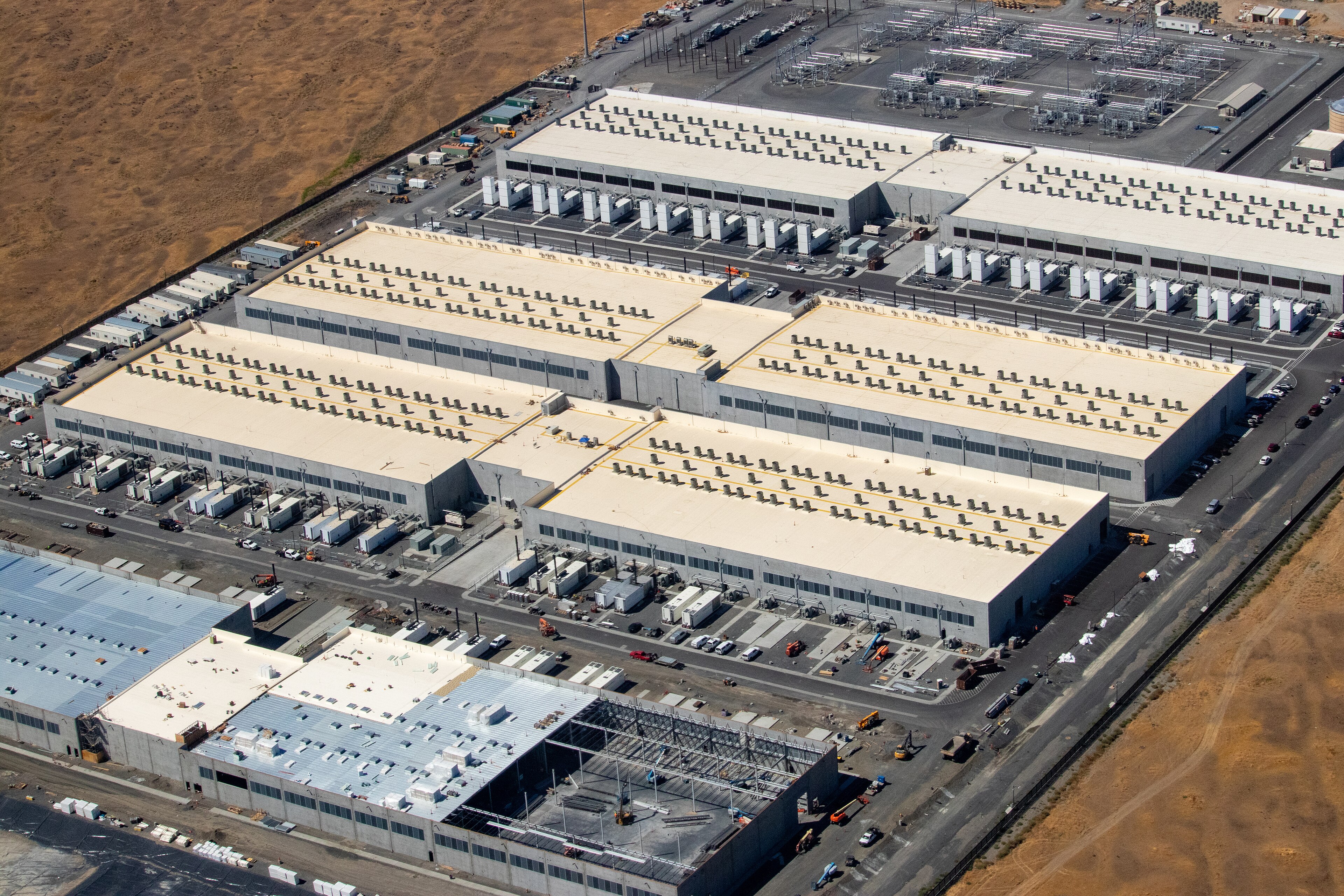

Amazon's capex of $77.3 billion exceeded operating cash of $42.4 billion
ComparedDo customers fill the capacity Amazon builds?
AWS backlog reached $578 billion, up from $496 billion at the end of June 23. Jassy told analysts on the call that "those big chunks are reserved well in advance because you cannot leave a gigawatt of capacity hanging around." He was describing single orders of "the hundreds of megawatts or sometimes up to a gigawatt of capacity."
That sentence supplies the unit the filing omits. Orders arrive in blocks of 100 megawatts to 1,000, and Jassy added a horizon: "We have very good visibility into 2027 and 2028 and some of 2029 too" 2. Visibility is a forecaster's word. Backlog is a figure Amazon publishes itself, and its customer and workload mix stay private. Jassy's only gigawatt reference described the size of single commitments, so the call reported capacity in dollars.
Doug Anmuth, an analyst at JPMorgan, asked about the money 2. He wanted Jassy to "just talk about the CapEx required to drive that kind of revenue over the next couple of years and beyond." Jassy answered with the size of the opportunity. "I think that the way we think about it, Doug, is that this is a once in a lifetime opportunity," he said, and Amazon expects to "spend meaningfully more in 2027 with a clear line of sight to attractive financial returns."
The question asked for a dollar figure. Jassy returned a direction and the phrase "meaningfully more," which leaves the ceiling open above the $220 billion planned for 2026. On funding, he was brief: "We can fund this plan."
Chips add a second source of demand. Jassy said on the call, "With Trainium demand so strong, customers continue encouraging us to make it available outside of AWS," and Amazon intends to sell the chip externally "late in 2027" 2. He also cautioned that "Selling external chips really is a very different business than your cloud infrastructure business." Read the second sentence as a reason for patience: Amazon plans to keep Trainium inside AWS for another year, where each chip earns rental revenue and adds to the backlog.

What does Tomasz Tunguz see in the same cash?
Tomasz Tunguz, a venture capitalist at Theory Ventures, wrote on July 30 that "Amazon now spends more on infrastructure than the whole company generates in cash" 3. He was reading the second quarter. In his July count AWS held the smallest backlog of the three large clouds, $496 billion against Microsoft's $678 billion and Google Cloud's $514 billion.
The third quarter widened the margin he described. Trailing free cash flow moved from negative $7.6 billion to negative $42.4 billion in one quarter, and the quarter's operating cash covered 55 percent of capex 4. His sentence has aged into a larger number. A venture investor who writes about cloud economics can afford to say it plainly, and Amazon's own filing now supplies the figures that his July arithmetic needed.
Investors priced the gap. Amazon raised $115.1 billion of debt in nine months, which makes the fourth quarter a first test of whether AWS growth outruns the interest bill. Shares closed at $243.79 on Oct. 29, down 4.25 percent before the release, and traded near $226 after hours, according to INDmoney's approximate snapshot 6. The pattern suggests the market read a borrower first and a cloud grower second.
Andy Jassy says Amazon can fund the plan; Tomasz Tunguz sees spending past cash
Both sidesWhy does the step stop at 0.4?
The capital component asks whether committed, closed financing pays for the buildout. A filing that prints $48.1 billion borrowed in a quarter and $115.1 billion across nine months is confirmed evidence, and the method places confirmed steps at 0.8 to 1.5. Three facts hold this one at 0.4.
First, debt shows access to money, and the filing and call leave megawatts energized unreported. Second, repayment rests on AWS revenue still to arrive, and $578 billion of backlog counts revenue, so margin on those contracts stays unknown. Third, free cash flow reached negative $42.4 billion.
The strongest fact against the headline is the debt itself, which rose 2.6 times in nine months. Coverage supplies the answer: the $578 billion backlog is 3.3 times the $173.1 billion of long-term debt, by this desk's arithmetic, and AWS earned $17.8 billion of operating income in one quarter. Backlog is revenue, so the coverage ratio overstates what lenders can claim. It still shows buyers committed to the capacity the debt builds.
What would each side need to be true? Jassy's side needs the fourth quarter to show backlog growing faster than debt while AWS margin holds near 38.7 percent. Tunguz's side needs another quarter with operating cash below capex and 2027 capex that lands well above $220 billion. The verdict is a 0.4 step up for financing that closed, and the action for a reader is to watch interest expense and the 2027 capex figure on the Q4 call.
What Amazon's filing shows, and what stays open for the fourth quarter
The recordThe data8 rows · sources
| Column | Item | Source |
|---|---|---|
| On the record | Long-term debt proceeds reached $48.1 billion in the quarter | [1] |
| On the record | Long-term debt stands at $173.1 billion, up from $65.6 billion | [1] |
| On the record | AWS net sales rose 39 percent to $46.0 billion | [1] |
| On the record | Trailing free cash flow reads negative $42.4 billion | [4] |
| Claimed or open | Megawatts energized stay out of the filing and the call | [2] |
| Claimed or open | The $578 billion backlog counts revenue, with margin unknown | [2] |
| Claimed or open | 2027 capex is only 'meaningfully more' than $220 billion | [2] |
| Claimed or open | Trainium external sales wait until late 2027 | [2] |
By the numbers
- $77.3 billion: purchases of property and equipment in the quarter, against $35.1 billion a year earlier 1.
- Operating cash flow of $42.4 billion covered 55 percent of that spending, by this desk's arithmetic 1.
- Long-term debt proceeds totaled $48.1 billion in the quarter and $115.1 billion across nine months 1.
- AWS net sales rose 39 percent to $46.0 billion, with operating income of $17.8 billion 1.
- Backlog stands at $578 billion, up from $496 billion at the end of June 23.
- Trailing free cash flow reads negative $42.4 billion, from negative $7.6 billion one quarter earlier 4.
- Guidance for 2026 cash capex holds near $220 billion, with 2027 spending "meaningfully more" 2.
What to watch
The Q4 call is the next test. Jassy promised only "meaningfully more" for 2027, so a dollar figure there sizes the borrowing ahead. Interest expense on $173.1 billion of long-term debt shows what the financing costs. A backlog that grows faster than debt, with AWS margin near 38.7 percent, would confirm Jassy's reading. Tunguz's reading gains force from a second quarter of operating cash below capex, funded by more debt.
Sources
- 1Amazon.com, Inc., Exhibit 99.1, Q3 2026 results, SEC EDGAR, Amazon.com, Inc., Oct. 29, 2026
- 2Amazon (AMZN) Q3 2026 Earnings Call Transcript, The Motley Fool, Motley Fool Transcribing, Oct. 30, 2026
- 3AWS's Road to a Trillion, Tomasz Tunguz, July 30, 2026
- 4Amazon posts negative free cash flow of $42.4 billion, holds 2026 capex unchanged, CNBC, Annie Palmer, Oct. 29, 2026
- 5Amazon Q3 2026 Earnings: AWS Booms, Free Cash Flow Sinks, Techloy, Ogbonda Chivumnovu, Oct. 30, 2026
- 6Amazon Q3 2026 Earnings Analysis: Why AMZN Stock Fell, INDmoney, Aadi Bihani, Oct. 30, 2026