Alphabet Rents Outside Compute as Google Cloud Doubles and Free Cash Flow Turns Negative
Alphabet's CFO Anat Ashkenazi said on Oct. 28 that Google began using third-party compute capacity as Cloud revenue rose 103 percent to $30.7 billion and free cash flow fell to negative $9.1 billion.
By Ryan Elliott Dennis · 5 sources · 6 min read
Alphabet reported on Oct. 28, 2026 that Google Cloud revenue reached $30.7 billion in the September quarter, up 103 percent, and that capital spending of $51.4 billion left free cash flow at negative $9.1 billion 1. Chief financial officer Anat Ashkenazi added a detail that changes how to read both numbers: Google started using third-party compute capacity at the end of the quarter 2. Shares fell more than 11 percent after hours, according to Fortune 3.
Alphabet's Oct. 28 report adds 0.5 points to compute
The moveThe data5 rows · sources
| Measure | Value |
|---|---|
| Reading before this day | 4.6 |
| This piece's move | +0.5 (Compute, confirmed) |
| Band for confirmed evidence | 0.8 to 1.5 |
| Reading after the day (with 1 other piece that day) | 4.8 |
| Distance to 100 | 95.2 |
What did Alphabet's filing show?
Alphabet's revenue rose 25 percent to $127.6 billion. Google Cloud operating income climbed to $11.1 billion from $3.6 billion a year earlier 1. Cash flow from operations came to $42.3 billion, and purchases of property and equipment came to $51.4 billion, with $132.0 billion spent across nine months. Alphabet held $265.1 billion in cash, equivalents and marketable securities.
The capex line doubled. FinanceFeeds puts the year-earlier quarter at $23.95 billion and free cash flow at positive $24.46 billion, a swing of about $33.5 billion in twelve months 4. Trailing twelve-month free cash flow fell to $19.75 billion from $73.55 billion. Guidance of $195 billion to $205 billion for 2026 is unchanged, and the nine-month total of $132.0 billion implies $63 billion to $73 billion in the fourth quarter, by this desk's arithmetic.
Sundar Pichai, Alphabet's chief executive, framed the quarter in the filing. "We had a strong quarter and are now on a half-trillion dollar revenue run rate," he said. A run rate annualizes the latest quarter, so $127.6 billion times four lands near $510 billion. The sentence leaves out the cash line.

Why does Google rent capacity it expected to own?
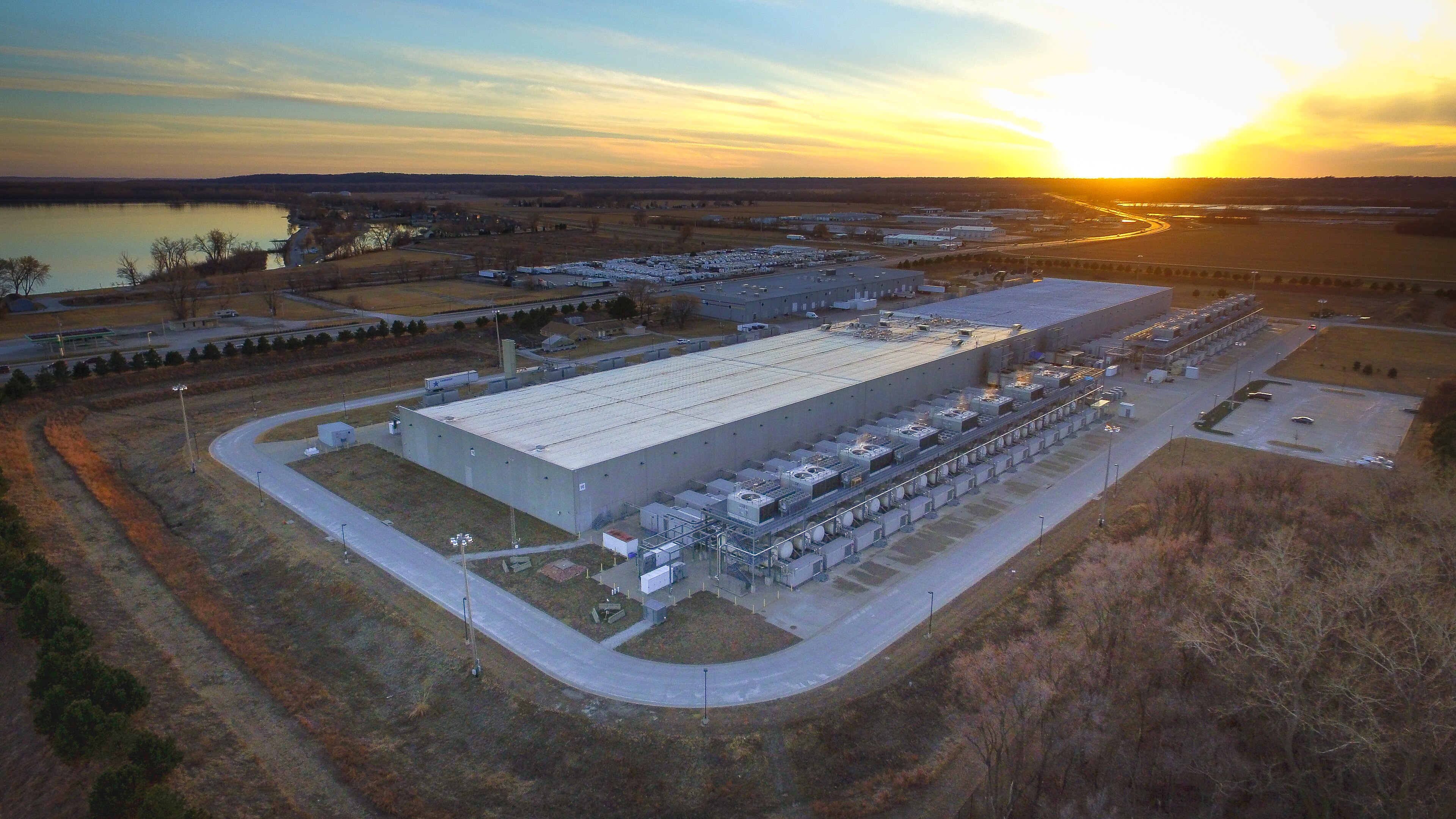
Ashkenazi tied the rental to demand. "We started utilizing third-party compute capacity at the end of Q3 and will ramp usage in Q4," she said on the call 2. She gave the reason as the "supply constrained environment," and the phrase is exact: Google, the owner of its own TPUs and its own data centers, ran short. Margins will feel it, she added: "We expect margin headwinds in the near term as we utilize this capacity."
How big is the demand? Cloud backlog, the contracted revenue yet to be recognized, stands at $561 billion, and a little over 55 percent of it converts to revenue within 24 months 2. That is about $308 billion in two years. Pichai described the signals in his own words: "we are working hard to bring more capacity online to meet this long-term demand." The verb "bring online" describes buildings and chips in progress, so the shortage is a matter of delivery dates, the same class of constraint that held Microsoft's quarter under plan on the same day.
Usage figures sit behind the revenue. The Gemini app reached 1 billion users, and first-party model APIs process about 32 billion tokens per minute 2. Those are measured volumes on Google's own systems, which makes the rental a response to traffic that already exists.
TPU sales add a second pull on cash. Thomas Kurian, chief executive of Google Cloud, said that "all of the inventory that -- for TPU systems are associated with committed contracts." Ashkenazi put the cash order plainly: "We build the inventory ahead of getting the revenue stream in." Chips bought before customers pay depress free cash flow in the quarter and lift revenue later, and management expects more TPU system sales to be recognized through 2027.

Google Cloud revenue rose 103 percent to $30.7 billion in a year
The numberThe data1 row · sources
| Measure | Value | Source |
|---|---|---|
| Year-over-year growth in Google Cloud revenue, quarter ended Sept. 30, 2026 | 103 percent | [1] |
Who pays for the gap?
Luke Lango, an independent tech analyst, names the funding source. "Alphabet is now funding the AI buildout with shareholders' money instead of its own cash," he wrote 3. Fortune notes that Alphabet announced in June it had raised $84.8 billion in equity, including $10 billion from Berkshire Hathaway. Lango's second sentence narrows the claim: "But make no mistake: this is a 'how do we pay for it' problem not a 'nobody wants it' problem."
Read his possessive. "Its own cash" separates what the business earns from what investors supplied, and the quarter's operating cash of $42.3 billion fell $9.1 billion short of capex. David Wagner of Aptus Capital Advisors sees the same split from the other direction: Cloud did its job, and "The problem is everything else," as Search grew 12 percent to $63.4 billion against the 15 percent investors expected 3.
Ashkenazi's reply points forward and offers more spending. "We continue to expect our CapEx to increase significantly in 2027, and we'll provide further details on our Q4 call," she said 2. Alphabet, with $265.1 billion in cash and securities, can cover 5.2 quarters of capex at the September pace, by this desk's arithmetic. Two items also depressed the quarter: a $5.2 billion payment tied to a 2018 European Commission fine and the TPU inventory build. Excluding the fine, free cash flow would have been about negative $3.9 billion, by the same arithmetic.
Wayne Cole of Global Banking & Finance Review shows how the market scored it. Shares fell about 10 percent after hours, and the same morning note says the market "rewarded those able to fund their own capex" 5. Microsoft, which reported the same day, qualified. Alphabet, at negative $9.1 billion, missed that bar.
Alphabet's capex of $51.4 billion exceeded operating cash flow of $42.3 billion
ComparedAnat Ashkenazi expects more capex; Luke Lango sees shareholders paying
Both sidesWhy does the step stop at 0.5?
The compute component asks whether frontier capacity is being built and used at scale. A Cloud line that doubled in a year, a $561 billion backlog and a filing that prints $132.0 billion of nine-month capex are confirmed evidence, and the method places confirmed steps at 0.8 to 1.5. Four facts hold this one at 0.5.
First, capex is dollars, and the filing omits megawatts and chip counts, so the ledger reads delivered capacity indirectly. Second, Ashkenazi says owned capacity fell short, which shows the build running behind demand. Third, free cash flow turned negative, and trailing twelve-month free cash flow fell by three quarters. Fourth, rented capacity belongs to its owners, and Alphabet's Cloud margin takes the cost.
The strongest fact against the headline is the balance sheet. Cloud operating income tripled and $265.1 billion of cash is on hand, so a quarter at negative $9.1 billion is affordable. The answer sits in the trend, which shows trailing cash generation down from $73.55 billion to $19.75 billion while capex is guided up again for 2027 4.
What would each side need to be true? Ashkenazi's side needs the fourth quarter to show owned capacity arriving, so the rented share shrinks while Cloud margin holds near 36.2 percent. Lango's side needs another quarter of negative free cash flow funded by new equity or debt. The verdict is a half-point step up for demand the filing measures, and the action for a reader is to watch the Q4 call for the 2027 capex figure and the share of Cloud capacity that is rented.
What Alphabet's filing shows, and what stays open for the fourth quarter
The recordThe data8 rows · sources
| Column | Item | Source |
|---|---|---|
| On the record | Google Cloud revenue reached $30.7 billion, up 103 percent | [1] |
| On the record | Capex was $51.4 billion and free cash flow negative $9.1 billion | [1] |
| On the record | Cloud backlog stands at $561 billion | [2] |
| On the record | Third-party compute use began at the end of Q3 | [2] |
| Claimed or open | Megawatts and chip counts stay out of the filing | [1] |
| Claimed or open | The rented share of Cloud capacity stays unquantified | [2] |
| Claimed or open | 2027 capex details wait for the Q4 call | [2] |
| Claimed or open | TPU inventory ties to committed contracts, by Kurian's account | [2] |
By the numbers
- Google Cloud revenue reached $30.7 billion in the September quarter, up 103 percent 1.
- Purchases of property and equipment totaled $51.4 billion, with $132.0 billion across nine months 1.
- Free cash flow came to negative $9.1 billion, against positive $24.46 billion a year earlier 4.
- Cloud backlog stands at $561 billion, and a little over 55 percent converts within 24 months 2.
- Operating margin in Google Cloud rose to 36.2 percent from 23.7 percent a year earlier 2.
- Cash, equivalents and marketable securities total $265.1 billion as of Sept. 30 1.
- Equity raised in June amounted to $84.8 billion, including $10 billion from Berkshire Hathaway 3.
What to watch
The Q4 call is the next test. Ashkenazi promised 2027 capex details there, and the share of Cloud capacity that comes from third-party providers shows whether owned supply is catching up. A Cloud margin that holds near 36.2 percent while rental ramps would soften the cost concern, and a second negative free cash flow quarter funded by new securities would confirm Lango's reading. Growth in the $561 billion backlog is the demand check.
Sources
- 1Alphabet Inc., Exhibit 99.1, Q3 2026 results, SEC EDGAR, Alphabet Inc., Oct. 28, 2026
- 2Alphabet (GOOGL) Q3 2026 Earnings Call Transcript, The Motley Fool, Motley Fool Transcribing, Oct. 29, 2026
- 3Alphabet's Google Cloud revenue doubles to $31 billion as cash flow stays deep red, Fortune, Amanda Gerut, Oct. 28, 2026
- 4Alphabet Stock $292 After Q3 Miss: -$9B Free Cash Flow, FinanceFeeds, Tobi Opeyemi Amure, Oct. 29, 2026
- 5Morning Bid: In the AI alphabet, cash is king, Global Banking & Finance Review, Wayne Cole, Oct. 29, 2026